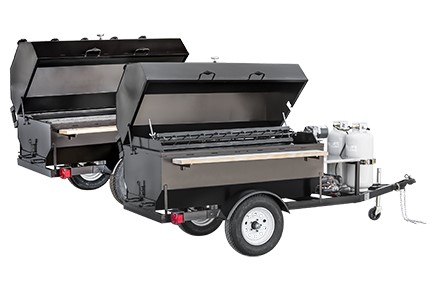
|

Big
John Grills
& Rotisseries
770
W. College Ave.
Pleasant Gap, PA 16823
800-326-9575
814-359-2755
Fax: 814-359-2621
|
 |
 |
| Gas
Grills |
 |
 |
 |
Country
Club Gas Grills
A4CC
A3CC
A2CC
|
Portable Gas
Grills
A4P
A3P
A2P |
SSE
Series Gas
Grills
A4CC-SSE
A3CC-SSE
A2CC-SSE |
Assembly -
Country Club Gas Grills |
-
Your
Country Club Grill is shipped upside down for protection. Unbox
the unit and, while upside down, attach the wheels.
-
Turn
the grill right side up.
-
Remove
all packaging materials, tape, and plastic coverings
|
|
Assembly -
Portable Gas Grills |
1. Remove
all packaging materials, tape, and plastic coverings. |
Assembly -
SSE Series Country Club Gas Grills |
- 1. Remove
all packaging materials, tape, and plastic coverings.
|
| Set
Up |
- These
Big John products are designed FOR OUTDOOR USE ONLY.
- Place grill
on a level area clear of combustible materials.
- Models purchased
without a stand, should be placed on a sturdy, level, non-combustible
surface that is capable of safely supporting
the weight of the grill.
- Securely connect
regulator to propane cylinder and test for leaks according to
the instructions in
the PROPANE SAFETY section
of these instructions.
- Place one
bag of lava rocks over burners in each section prior to igniting.
- Place
cooking grates on unit.
- We recommend
curing your grates by applying a coat of vegetable oil to the
grates, then heating the grates
for approximately
20 minutes, prior to using the grates for the first
time.
|
Operation |
- Prior to opening
main cylinder valve, and lighting grill, place all control knobs
in
the "CLOSED" position (turned
to the left).
- Open main
cylinder valve. Hold a lit butane gun next to a burner
and turn the burner control knob to "OPEN" (pointing
at you). The burner will ignite instantly. The second burner
in each section will instantly light by simply turning
it on. Since
each section is ignited separately, only light the section
required.
- Once burners
are lit, adjust the control knobs to desired temperature.
- When
finished cooking close all control knobs, close main cylinder
valve and disconnect propane cylinder.
- Clean grates
with non-metallic pad (like Scotch-Brite) while grates are still
hot. DO
NOT USE A WIRE BRUSH ON STAINLESS STEEL GRATES.
- Cast
Iron Grates must be protected from moisture and stored with
a coating of vegetable oil to prevent
rusting.
|
| Propane
Safety |
- Never use
or store cylinders indoors.
- Keep main
cylinder valve securely closed when not in use. WARNING: Propane
tank valves are designed
to work completely open and/or
completely closed. Never just crack the valve.
- Always position
the LP cylinder so that the connection between the valves and
the regulator will not cause sharp
bends in the hose.
- The POL connector
on the regulator screws in to the valve outlet of a 30 lb. cylinder,
by turning counterclockwise
(to
the left) only.
- Make sure
the connector is free from scratches or nicks which can cause
leaks.
- There are
two (2) types of connectors (see Diagram A and Diagram B)
- DISCONNECTING
AND TRANSPORTING CYLINDERS FOR REFILLING:
1. Turn off all control knobs and close the main cylinder
valve.
2. Place cylinder plug snugly in the main cylinder
valve outlet.
3. Always transport and store LP cylinders in
a secured, upright position.
4. Never keep propane cylinders in a hot car
or truck. Heat could cause the relief valve to
discharge propane
and create
a dangerous
situation.
- RECONNECTING
A FILLED 30 lb. CYLINDER:
- Remove
the main cylinder valve plug.
- Thread
the POL Connector snugly into the main
cylinder valve by turning counterclockwise
(to the left).
- What you
do next depends on whether you have a soft nose connector
with a rubber
ring or a
hard nose connector:
- WITH A SOFTNOSE
CONNECTOR (DIAGRAM A):
If there is a handwheel, tighten firmly by
hand, or use a wrench. DO NOT OVERTIGHTEN.
The rubber
O ring must
be in
place on soft
nose POL connectors, otherwise it may not
seat and form a good seal.
- WITH A HARDNOSE
CONNECTOR (DIAGRAM B):
Use 8" adjustable wrench. Tighten firmly but do not use
excessive force.
- Always test
for leaks according to the diagram below.
- If you suspect
a problem, have your grill or tank serviced by a qualified propane
dealer.
|
 |
 |
| Additional
Information |
|
|
|
|